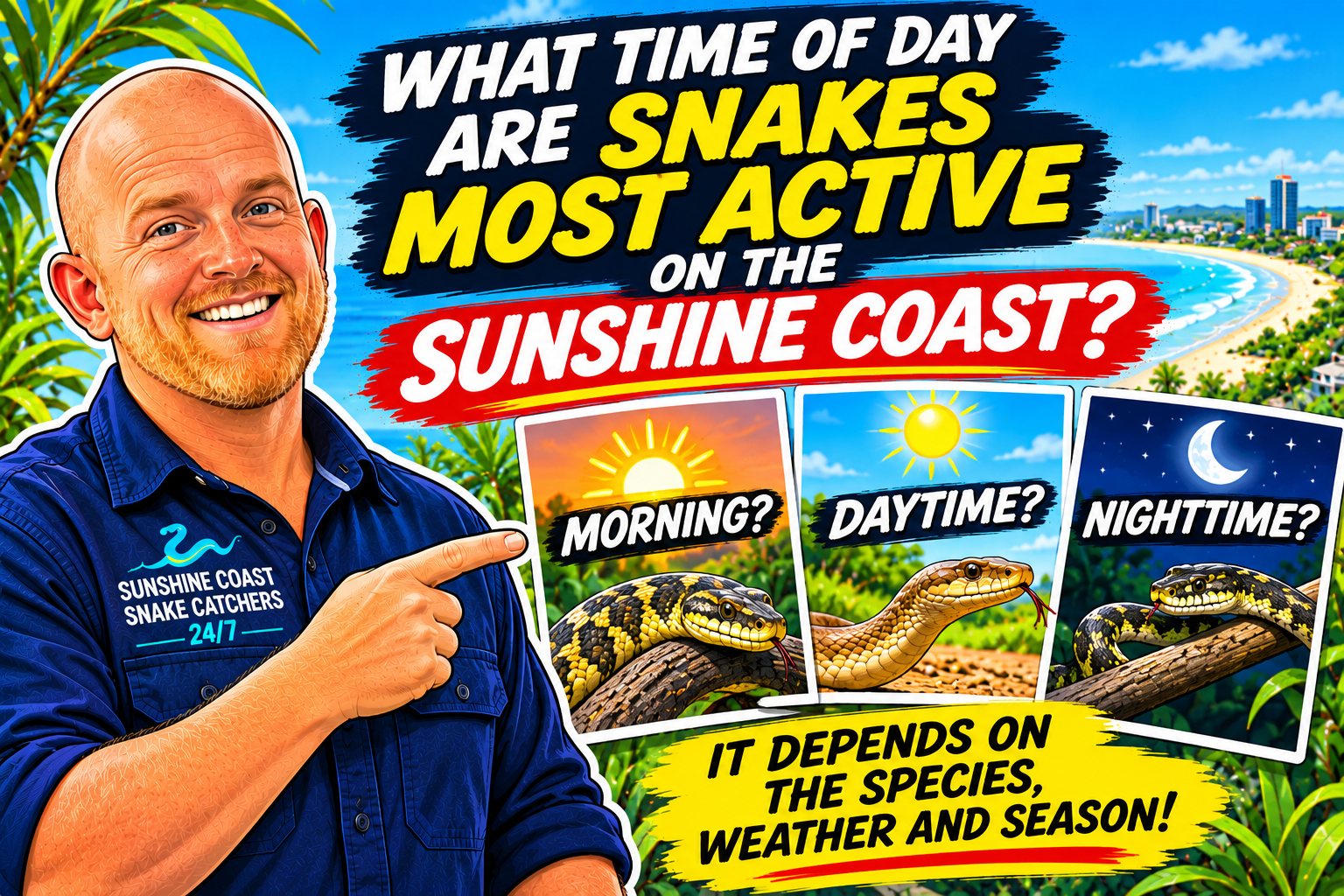
Cartoon illustration of Stuart from Sunshine Coast Snake Catchers 24/7 explaining when snakes are most active, featuring morning, daytime and nighttime snake activity against a Sunshine Coast backdrop.

What Time of Day Are Snakes Most Active on the Sunshine Coast?

By When Are Snakes Most Active

What Time of Day Are Snakes Most Active on the Sunshine Coast?

It’s 7 am, the sun is shining, and you’ve decided to get a head start on the gardening before the Sunshine Coast heat kicks in.

You grab your gardening gloves, head outside and suddenly spot something slithering across the lawn.

A snake!

But hang on. Aren’t snakes supposed to come out when it’s hot?

Actually, not necessarily.

One of the most common questions homeowners ask is when are snakes most active, and the answer might surprise you.

While many people associate snakes with scorching summer afternoons, their activity patterns depend on temperature, weather, species and the time of year.

Some snakes prefer the warmth of the morning sun. Others become more active after dark.

So, when are you most likely to encounter a snake around your Sunshine Coast home?

Let’s find out.

Read More

Cartoon illustration of Stuart from Sunshine Coast Snake Catchers 24/7 pointing towards a relocated snake, with a Sunshine Coast beach backdrop and the blog title "Do Snakes Come Back After Being Relocated?"

Do Snakes Come Back After Being Relocated?

By Do Snakes Return After Removal

Do Snakes Come Back After Being Relocated? The Truth Might Surprise You

You’ve spotted a snake in your Sunshine Coast backyard, called a professional snake catcher and watched the unexpected visitor disappear safely into a secure transport container.

Problem solved, right?

Well, hopefully. But there’s one question that often crosses a homeowner’s mind afterwards.

Do snakes come back after being relocated?

It’s a perfectly reasonable concern, particularly if the snake was discovered near your front door, swimming pool or children’s play area.

The answer is a little more complicated than you might expect.

Some snakes are capable of finding their way back towards familiar areas. However, whether a relocated snake returns depends on several factors, including its species, the distance travelled, the surrounding habitat and the relocation circumstances.

And here’s something else worth knowing: if another snake appears in your backyard next week, it might not be the same snake at all!

Let’s explore what really happens after snake relocation and why some Sunshine Coast properties experience repeated visits.

Read More

Stuart from Sunshine Coast Snake Catchers 24/7 explaining how snakes climb walls, fences and enter roof spaces

Can Snakes Climb Walls, Fences and Even Get Into Your Roof?

By Can Snakes Climb Walls

Can Snakes Climb Walls, Fences and Even Get Into Your Roof?

Imagine sitting outside enjoying a beautiful Sunshine Coast afternoon when you notice something moving along your fence.

At first, you assume it’s a branch blowing in the breeze. Then you look again.

It’s a snake. And it’s climbing!

For many homeowners, discovering a snake in the backyard is unsettling enough. However, watching one scale a fence, climb a wall or disappear into the roof can be a completely different experience.

So, can snakes climb walls, fences and even reach the roof of your home?

The short answer is yes. Some Australian snakes are surprisingly accomplished climbers, although their abilities vary considerably between species.

Let’s explore how they do it, which Sunshine Coast snakes are most likely to climb and what you can do to reduce the chances of an unexpected visitor turning up above your ceiling.

Read More

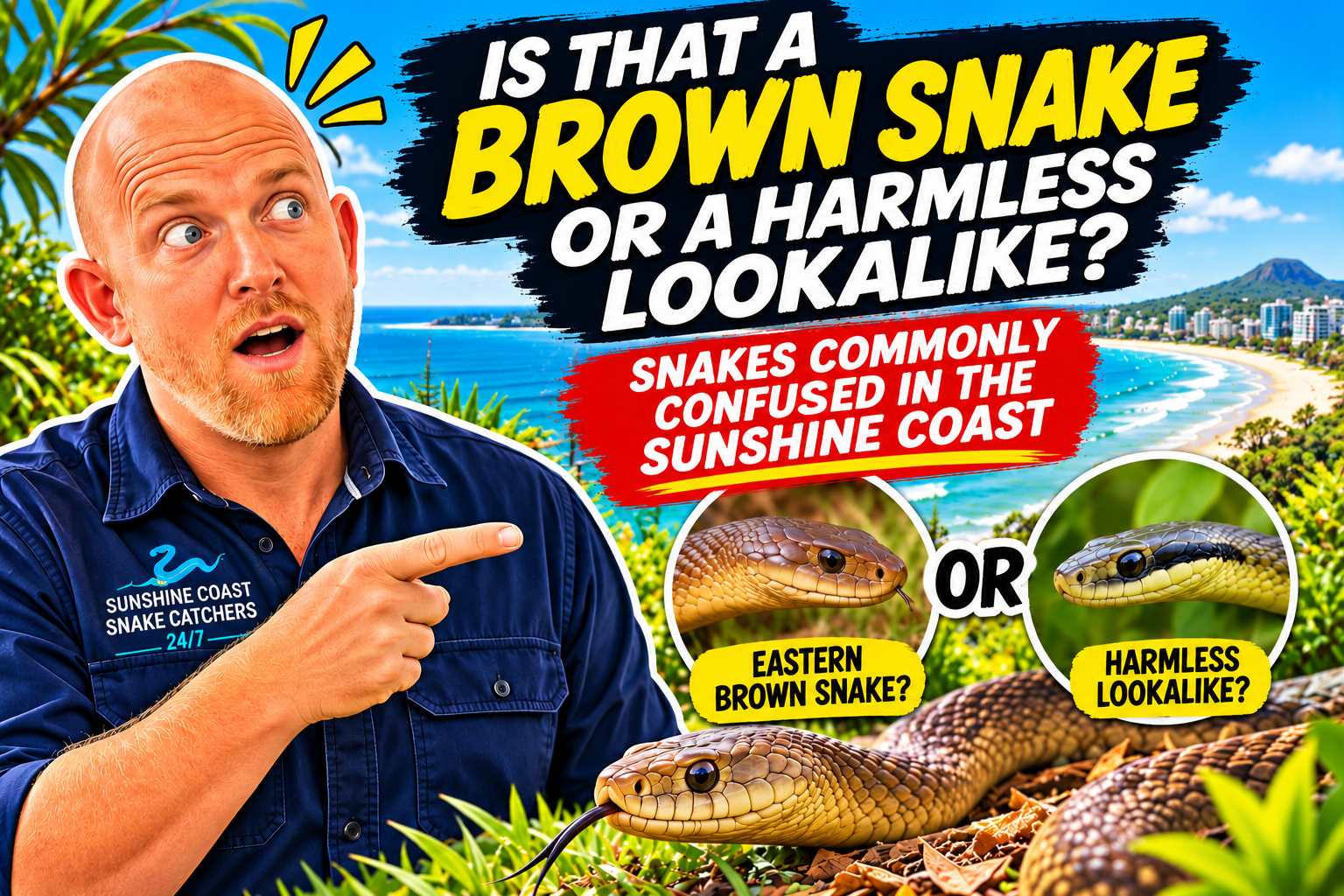
Stuart from Sunshine Coast Snake Catchers 24/7 looking surprised while comparing an eastern brown snake with a harmless lookalike, against a Sunshine Coast beach backdrop. Confued.

Is That a Brown Snake or a Harmless Lookalike? Snakes Commonly Confused on the Sunshine Coast

By How to Identify a Brown Snake

Is That a Brown Snake or a Harmless Lookalike? Snakes Commonly Confused on the Sunshine Coast

You’re walking through your Sunshine Coast backyard when something long, slender and brown suddenly moves across the grass.

Your first thought?

“That’s a brown snake!”

But is it?

When it comes to brown snake identification, appearances can be incredibly misleading. Not every brown-coloured snake is an eastern brown snake, and not every eastern brown snake is actually brown.

Confused already? You’re certainly not alone.

The Sunshine Coast is home to numerous snake species, and several share similar colours, body shapes and behaviours. While some are harmless to humans, others are highly venomous.

So, how can you tell the difference, and more importantly, what should you do if you’re unsure?

Let’s explore some of Sunshine Coast’s most commonly confused snakes.

Read More

What attracts snakes to homes cover image. Stuart looking like he's deep in thought in a back garden.

What Attracts Snakes to Your House? 9 Things Sunshine Coast Homeowners Overlook

By what attracts snakes

What Attracts Snakes to Your House? 9 Things Sunshine Coast Homeowners Overlook

You keep your lawn tidy, your garden looks fantastic, and you’ve never deliberately invited a snake over for a visit. So why has one suddenly appeared beside your patio?

It’s a question plenty of Sunshine Coast homeowners ask, particularly as the weather warms up.

The surprising truth is that what attracts snakes to your property often has very little to do with the snake itself. Instead, it’s usually something you’re unknowingly providing.

Food, shelter and suitable temperatures are the main attractions, and even the nicest Sunshine Coast backyard can offer all three.

Before you start worrying about every rustle in the garden, here are nine things that could be making your home particularly appealing to our slithery neighbours.


Read More

Cartoon image of Stuart McKenzie and a snake in a back yard

What Should You Do If You Find a Snake in Your Backyard?

By I Found A Snake In My Yard, Snake In Yard No Comments

What Should You Do If You Find a Snake in Your Backyard?

Picture this. It’s a beautiful sunny afternoon on the Sunshine Coast. You’re enjoying a cuppa on the patio, the kids are playing outside, and suddenly you spot something slithering across the lawn.

A snake!

For many homeowners, discovering a snake in the backyard is enough to send them straight back inside.

But before you panic, it’s worth remembering that snakes are a natural part of life here on the Sunshine Coast. Most aren’t interested in people and would much rather disappear into the nearest garden bed than have anything to do with us.

However, knowing what to do when you encounter one can make all the difference.

Stuart McKenzie and the team at Sunshine Coast Snake Catchers 24/7 have been professionally relocating snakes for over 15 years. Here are their tips for handling an unexpected backyard visitor.

Read More

Cartoon of Stuart McKenzie, a snake and some money as a promo image for blog

Why Do Snake Catchers Charge in Queensland?

By Why Do Snake Catchers Charge No Comments

Why Do Snake Catchers Charge in Queensland? And Why Isn’t Snake Removal Free?

You’ve just spotted a snake slithering across your backyard, disappearing underneath the deck or, even worse, making itself comfortable inside your house.

Naturally, your first thought probably isn’t about money. It’s more likely to be something along the lines of, “How on earth do I get that thing out of here?”

But once you’ve decided to call a professional snake catcher, another question often comes up.

Read More

SNAKES & PETS

By Recent No Comments

In the warmer summer months from September to March, snakes become much more
active and pet owners need to be careful to safeguard their pets from snake bite, as well
as know how to recognise the signs and symptoms of snake bite.
Dogs will often try to chase or kill snakes resulting in bites usually to the dog’s face and
legs. Cats, being instinctive hunters, are also quite susceptible to snake bites.

Read More

SNAKE BITES

By Recent No Comments

In Australia estimates of snake bite have reduced from around 3000 to 1000 bites per. This
is largely a result of the increasing public awareness about snakes. As 95% of people who
are bitten are trying to catch or kill the snake it seems obvious that the more we leave
snakes alone the more the annual bite rate will continue to decline. Of the previously
mentioned 1000 people who are bitten each year only around 200-300 require
hospitalisation and anti-venom, out of that only 1-4 people die annually from a snake bite.
This is a very low mortality rate for a country with over 24 million people. Read More